XREAL AURA contra Apple Vision Pro: què sabem després de dues hores de prova
Les AURA prometen Android XR, 70 graus i menys pes per menys de 1.500 dòlars. Separem la demo del producte final i expliquem per què no substitueixen directament Vision Pro.
Les XREAL AURA intenten portar finestres espacials, seguiment de mans i Android XR a unes ulleres òpticament transparents connectades a un ordinador de butxaca. Samuel Nam hi va passar aproximadament dues hores en una demostració prèvia al llançament i va sortir impressionat pel camp de visió, el seguiment del cap i la comoditat.
El titular les enfronta a les Apple Vision Pro de 3.500 dòlars, però no són substituts directes. AURA deixa veure el món a través de les lents i separa el càlcul en un puck amb cable; Vision Pro és un visor tancat que reconstrueix l’entorn amb càmeres i integra una plataforma diferent. La comparació serveix per preguntar què necessita cada usuari, no per declarar un producte «inútil».
XREAL va pagar el viatge del creador, tot i que ell afirma haver rebutjat una tarifa de patrocini i diu que la marca no va revisar el vídeo. És una transparència important. Continua sent, però, una prova organitzada pel fabricant amb maquinari de preproducció.
La primera impressió: una interfície familiar
Al minut 1:02, Nam completa el tutorial d’Android XR: gira el canell per obrir la pantalla principal, assenyala i pessiga per seleccionar i arrossega finestres perquè quedin ancorades a l’espai.
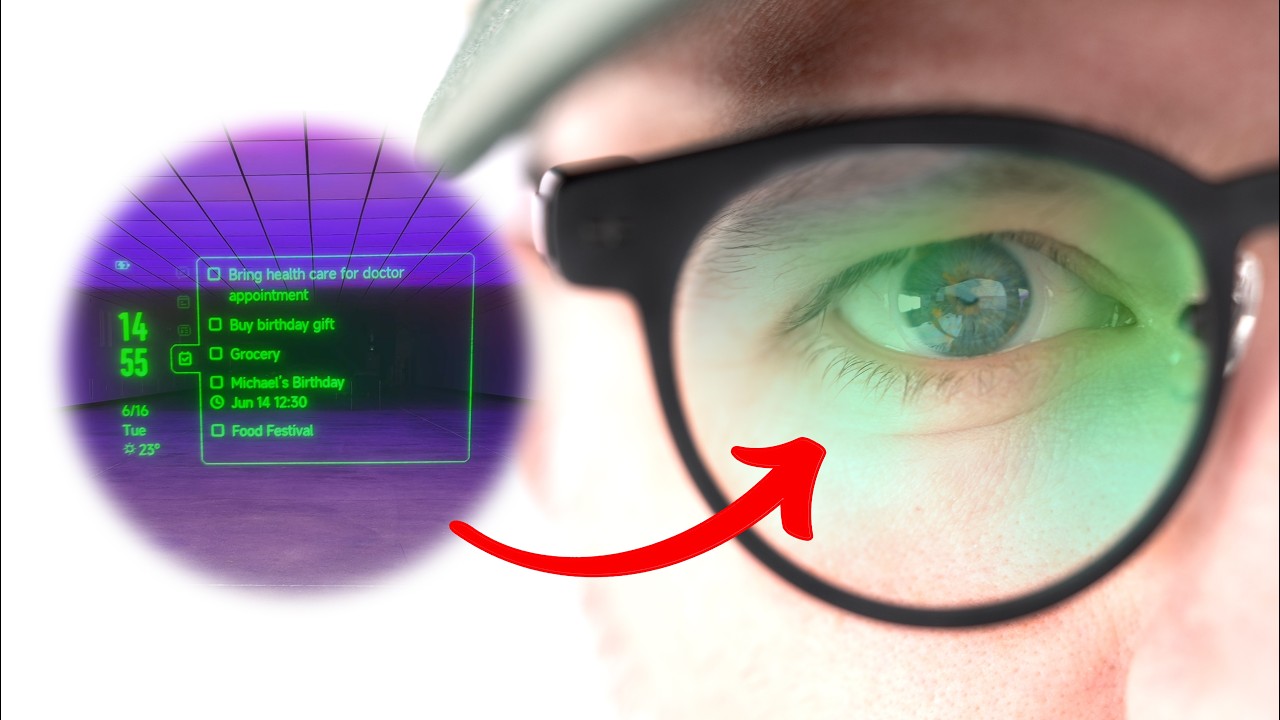
El seguiment del cap li sembla estable fins i tot quan intenta provocar-lo amb moviments ràpids. També destaca l’atenuació electrocròmica, que pot fer més visibles els continguts sense tapar del tot l’exterior.
Són observacions valuoses, però qualitatives. No hi ha mesures de latència, deriva, precisió o rendiment en llum variable. Una hora de tutorial tampoc mostra què passa després d’una jornada de videotrucades, text petit i múltiples aplicacions.
Què especifica XREAL avui
La fitxa oficial d’AURA confirma:
- pantalla Micro-OLED Sony de 1.920 × 1.200 píxels per ull;
- camp de visió de 70 graus i fins a 120 Hz;
- dues càmeres de seguiment, 6DoF i control amb mans;
- càmera d’alta resolució amb indicador de privacitat;
- cinc nivells d’atenuació electrocròmica;
- Android XR, Gemini i aplicacions de Google Play;
- dues configuracions de memòria i emmagatzematge al puck;
- bateria de 4.455 mAh i entrada DisplayPort per USB-C.
El preu final del model base no superarà els 1.500 dòlars abans d’impostos, segons XREAL, i el llançament està previst per a la tardor de 2026. La reserva actual no és una comanda definitiva: configuracions, preu final i data d’enviament s’han d’anunciar més endavant.
A 26 de juliol de 2026, per tant, encara no hi ha un producte comercial final que es pugui avaluar a llarg termini.
El salt important és el camp de visió
Al minut 5:50, un representant de XREAL diu que el canvi d’una òptica birdbath triangular a un prisma pla amplia el camp de 46 a 70 graus alhora que redueix la mida física de les lents.
Nam ho percep immediatament quan compara AURA amb les seves XREAL anteriors: veu més superfície vertical, menys reflexos i una imatge més còmoda fora d’una habitació fosca. La resolució, en canvi, continua sent un límit per a textos i edició fina.
El camp de visió determina quina part de l’entorn es pot cobrir amb contingut digital. La resolució per ull no explica tota la nitidesa: també compten píxels per grau, òptica, ajust interpupil·lar, contrast, escala del text i posició de la lent. Caldrà provar documents, terminals i tipografies reals abans de vendre AURA com a substitut d’un monitor.
Per què hi ha un ordinador de butxaca
Al minut 6:18, XREAL respon que un telèfon no ofereix per si sol l’ordinador espacial que necessita el dispositiu. El puck allotja Android XR, el processador Snapdragon Reality Elite, memòria, bateria i connexions. Les ulleres conserven un coprocessador X1S per al seguiment i la presentació de baixa latència.
Separar pes, calor i bateria del cap és una decisió sensata. També significa:
- un cable entre ulleres i butxaca;
- un segon dispositiu que s’ha de carregar;
- més volum total del que suggereixen només les ulleres;
- dependència del puck per a l’experiència completa;
- un nou punt de fallada i una peça addicional a transportar.
La pantalla tàctil del puck pot funcionar com a punter quan el seguiment de mans falla, per exemple en foscor. És una alternativa útil i un recordatori que els gestos no resolen tots els contextos.
AURA i Vision Pro resolen compromisos diferents
Apple Vision Pro amb M5 pesa oficialment entre 600 i 650 grams, sense comptar una bateria externa de 353 grams. Utilitza el xip M5 i l’R1, una matriu extensa de càmeres i sensors, entrada amb ulls, mans i veu, i una pantalla que mostra una reconstrucció del món exterior. Apple indica fins a 2,5 hores d’ús general o 3 hores de vídeo.
AURA posa molta menys massa al cap i conserva visió òptica directa de l’entorn. A canvi, el seu camp digital de 70 graus no ocupa tota la visió i la pantalla de 1.200 píxels verticals per ull és una altra categoria de densitat i immersió. Vision Pro pot oferir oclusió, entorns tancats i seguiment ocular; AURA prioritza portabilitat i consciència de l’exterior.
La pregunta útil és:
| Necessitat | AURA pot encaixar millor | Vision Pro pot encaixar millor |
|---|---|---|
| Veure l’entorn directament | Sí, òptica transparent | Mitjançant càmeres |
| Portar poc pes al cap | Prioritat del disseny | Visor molt més pesant |
| Immersió completa | Limitada pel camp transparent | Entorns i vídeo envoltant |
| Ecosistema | Android XR i Google Play | visionOS i integració Apple |
| Equip extern | Puck i cable | Bateria externa i cable |
| Text i treball precís | S’ha de validar | Maquinari més dens i car |
No hi ha un guanyador universal perquè les renúncies són diferents.
Seguiment de mans: prometedor, encara no concloent
Al minut 3:49, Nam considera que Vision Pro és més sensible i precisa, però que AURA manté bé els objectes ancorats i detecta consistentment la mà quan gira el canell.
Ell mateix admet que una hora no li basta per sentir-se còmode movent finestres. Una prova completa hauria d’incloure:
- mans de diferents tons, mides i mobilitat;
- llum solar, interiors i foscor;
- mans parcialment fora del camp de les càmeres;
- selecció de botons petits i escriptura prolongada;
- moviment en tren o avió;
- fatiga dels braços i falsos gestos;
- accessibilitat amb veu, ratolí o controlador.
Una demo amb deu intents reeixits no mesura taxa d’error ni aprenentatge.
El cas d’ús més creïble és seure
Al minut 8:09, el creador descarta la idea de portar-les tot el dia mentre compra o camina. El cable, el puck i la forma lateral fan que les vegi més adequades per a una taula, un sofà, una cafeteria o un avió.
Els usos que li resulten convincents són una pantalla privada gran per a vídeo i jocs i un espai de treball portàtil amb diverses finestres. Mapes immersius, pintura i jocs de taula li semblen més aviat demostracions a la recerca d’una aplicació imprescindible.
Aquest és un criteri de compra millor que la semblança amb Vision Pro. Abans de reservar, convé preguntar:
- puc llegir el meu editor o full de càlcul durant dues hores?
- necessito teclat i ratolí externs?
- les meves aplicacions funcionen realment en Android XR?
- tolero el cable i el pes a la butxaca?
- com es comporta amb ulleres graduades o insercions?
- quina autonomia, garantia i política de devolució tindrà la versió final?
Privacitat i seguretat al món real
AURA incorpora càmeres i micròfons orientats a l’entorn, i Gemini pot interpretar allò que l’usuari veu amb permís. XREAL anuncia un LED de privacitat, però un indicador no resol per si sol consentiment, retenció, processament al núvol ni normes en espais de treball.
També cal evitar caminar mirant finestres que ocultin obstacles. La transparència òptica preserva el món real, però el contingut pot captar l’atenció. Les organitzacions hauran de decidir on es poden usar càmeres, quines aplicacions accedeixen als sensors i com es protegeixen documents en pantalles espacials.
Apple descriu un enfocament diferent: processa dades de càmeres i sensors al sistema perquè les aplicacions no necessitin veure l’entorn, i no comparteix l’entrada ocular amb aplicacions o webs. Per comparar privacitat caldrà la documentació final d’Android XR i XREAL, no només el nombre de càmeres.
En resum
La prova de Samuel Nam suggereix que XREAL ha millorat dos límits històrics de les seves ulleres: camp de visió i reflexos. Android XR, el seguiment 6DoF i el puck converteixen AURA en molt més que una pantalla connectada al telèfon. El preu màxim anunciat també queda molt per sota de Vision Pro.
No fa que el visor d’Apple sigui «inútil». AURA ofereix menys immersió i una resolució que el mateix creador considera justa per a text, mentre Vision Pro és molt més pesant i car. I encara falten proves independents de bateria, comoditat, aplicacions i versió final.
La promesa més realista no és substituir tots els ordinadors ni portar les ulleres pel carrer. És disposar d’un monitor privat i espacial que cap en una bossa. Si la versió comercial manté l’estabilitat de la demo i el text és prou nítid, aquest cas d’ús pot ser més important que qualsevol comparació espectacular.
Contrast i context
Fonts consultades
- 01
- 02
- 03
-
04
Apple Apple Vision Pro
Font de treball
Transcripció amb marques de temps
Consulta la transcripció
-
0:00
, obre el vídeo en una pestanya nova
I've always got a kick out of doing dumb-ass portable workstation setups like using a Mac mini with a Vision Pro out in public or using the XREAL and Dex mode for a week at cafes. All of these were fun, but they actually sucked balls in reality. My wife couldn't stand it. >> You're getting more reviews. >> XREAL and Google are claiming to have created the Vision Pro experience with just these glasses that weigh like 95 g. This video isn't sponsored by anyone, by the way, so I can get you guys an honest look at this thing. In this video, I'll test how good the head and hand tracking is, how clear the text is for the coders and graphic designers, and compare it to the previous XREAL products. I'll also test how comfortable it is, too. Okay, humans, I flew 7,500 mi to see this XREAL Aura in person, and my wife knows how excited I am for this product. Let's go and see what my wife thinks of my fashion. >> You don't look normal. >> They look perfect. >> So, I'm going to go up and see it in 30 minutes. Let's go together. >> All right, let's try this on. >> You can go ahead, and I'll start by putting you into an input onboarding tutorial. Flash through, and then you'll hear somebody narrate. >> So, obviously, this is just complete posture. Ooh. >> So, let's learn how to get around. >> see this uh welcome screen. And so, the first stage is going to introduce you to the gestures.
-
1:19
, obre el vídeo en una pestanya nova
>> Then quickly pinch and release each object. >> Wait, what? Oh. Friggin' hell, look at this. So, what this is This is stuck to >> It's world locked, yeah. >> Guys, this is crazy. >> So, once you do get your Galaxy XR, this is uh >> Once I do? >> the exact same uh information >> Oh, wow. Oh, yeah, sorry. Sorry, I might as well click this on. >> So, right now he's actually sequence breaking the tutorial. >> During my 1-hour demo, I got to interact with Android XR for the first time, and it felt incredibly intuitive and familiar. >> Drawing in the freaking toilets. >> Like you rotate your wrist and pinch to open the home screen, point at the app and pinch to open, point at the edge, pinch and hold to drive windows around. >> So it doesn't want to bother you. >> Oh, this is crazy. >> Use your other hand to open tools in apps or extra menus for games. Also, if you turn on the dimming and you turn to look at a human head, the dimming turns off automatically. Which was pretty cool. The head tracking was surprisingly good. So I tried to break the tracking. >> It shouldn't be this good. What if I just Far out. >> Yeah.
-
2:31
, obre el vídeo en una pestanya nova
>> What if I just Whoa! Bro, this is like Vision Pro level. The most impressive to me was the eye comfort compared to the previous Xreal glasses. So I compared them on the spot. These are the Xreal ones I've been using for the past year, yeah? And I assumed this would be heavier, right? Cuz you're doing Vision Pro level stuff on glasses, so I assumed they'd be heavier, but it's not. They feel the same. Now, how's the clarity? The clarity feels similar. I think the resolution is kind of the same, but the aspect ratio is different. Vertically it's probably higher. Let me just plug this into my phone, and I just want to do like a side-by-side comparison. Oh, bro. Immediately I can see so much with I can see my pants. I'm not even joking. Yeah, okay, the field of view sucks. And it's so reflective it's not even funny. No. Okay. Okay, there's a huge Okay, in terms of hardware there's a huge difference. This is super reflective. And it does annoy you, especially when you're using it not in a pitch-black room. Whereas this thing, I feel fine. There's barely any reflections. It feels much more comfortable to use longer periods. Uh that's a bigger deal than I thought. You got two cameras that's doing all the tracking, and then you got an actual RGB camera, so that Gemini knows what you're looking at, and you can ask it questions, and apps can plug into it straight away, and you can do
-
3:48
, obre el vídeo en una pestanya nova
things with that as well. Oh, and for the dads who want to know if it works on kids, I tested it on both my fat babies. I can confirm you will get absolute instant silence with this tool. Does it sound like we don't have kids at our house? Because you know what? We do. These glasses on them and they just not saying a word. Am I the best dad? Am I the best daddy? They don't even reply. I wanted to talk about the the finger tracking thing. How how good was it compared to Vision Pro? Now, the Vision Pro does feel a little bit more sensitive and a little bit more accurate because there are six cameras on your face. However, the Xreal Air was wasn't far behind. It didn't like the head tracking felt legit. Like it actually felt like the Vision Pro in terms of like things being in place, right? But the hand tracking, I feel like 1 hour wasn't enough time, but it didn't feel comfortable to like move things around. Like I wasn't like bang bang bang bang like Like I wanted to do that like Iron Man. But when it comes to like recognizing your hand when you turn your hand, it always worked um 10 times out of 10. It is a very impressive piece of tech because they were able to kind of mimic like 90% of the Vision Pro with just two cameras up here, which is insane. All in
-
5:15
, obre el vídeo en una pestanya nova
all, I think this is exciting. I cannot wait till Apple makes their version. Snapchat actually made augmented reality glasses and the features look insane. But dude, you look like an absolute nut job wearing that thing. I sent a photo of it on my face to my wife and she said, "You will still be single." Whilst I was in LA, I posted up what you guys wanted to know about the Xreal Airs. And instead of answering them myself, I had the privilege of chatting with Ralph, who is basically the face of Xreal in America. Dude, thanks for doing this for me. >> Happy to do it. Thanks for checking us out. >> Now, first question I have, why are we using a puck instead of our phone? >> Yeah, it's a great question and it it's a pretty simple answer. It's because the puck is a full-on AI spatial computer and your phone's not. >> Now, I've been a user of the previous XREAL stuff since the Air 2 Pro and the immediate thing I noticed when I chucked these on is the field of view is massive. Can you explain how you guys did that? >> Yeah, and you nailed two of the important things. So, the field of view went up while physically the lenses got smaller. And then we were able to shrink that down by 15% but make the screen more than 44% larger. So, we went from a triangular bird bath to a flat prism lens and this is smaller but bigger, right? It's much smaller physically but it gives you a 70° field of view. So,
-
6:40
, obre el vídeo en una pestanya nova
you go from 46° to 70°. It is a massive field of view. >> Has there been a resolution increase and why aren't we seeing at least 1440p? >> This is 1200p, you're right. We know how to go higher than that in the future but one of the things also is it's expensive. We're not ready to sell a $4,000 device. We could but that's not accessible to anybody. >> How much is it going to be? >> I see what you're doing. It will be below $1,500. >> Does it work in a plane, in a car, in a train? That was one of the questions that they asked. >> Yes. All of them. Yeah, it's really cool. There's a travel mode that automatically kicks in if it notices drift. >> What has been the most useful realistic use case >> Yeah. >> for you? >> I work in my XREAL glasses honestly 4-5 hours a day. Like I'm a power user. I took my monitors off my desk in my office. Like I will work 4-5 hours a day in mine. >> Yeah. When can I take this and can I be the first one to use it? >> It's coming soon. It will launch this fall. We'll make sure you get it a little earlier than the average customer. >> Now, someone asked it looks when you're just walking around. From the front, it
-
7:46
, obre el vídeo en una pestanya nova
kind of looks like normal Ray-Bans, but from the side, you do look like a douchebag, and the glasses sit a little further away from your face. But, why the hell do you care if you got spatial computing at your fingertips and a 300-in monitor to play Forza Horizon on the plane? Another great question was, "What the hell is this even for?" I reckon this will be an awesome entertainment device when you're chilling at home, like watch YouTube, connect your Switch or your Steam Deck to it, and then a productivity device when you're on the go or traveling. By the way, after using the XREAL Air for an hour, one thing is very clear, these were not made for you to walk around and just live life, go shopping, and you want to be sitting down, either at a desk, at a cafe, on your couch, at the beach, or whatever. In the plane, it's not a fashionable thing, like you got this cable hanging out the side, you've got this puck you've got to attach to your pants. I would personally do it. I'll probably live with it for like 3 weeks straight. Like, uh during the demo, they did show off some impressive games, but I just can't imagine calling the boys over and everyone wearing these playing a board game like a bunch of idiots. Like, I just don't see the actual use case of that. Do you know what I mean? Actually, that's probably exactly what I'll do when I get my review unit. It seemed like everything that they were showing off to me was like a showcase for the technology, but
-
9:12
, obre el vídeo en una pestanya nova
it's not like we haven't seen the technology before. We have seen them. It is the first time seeing this technology in like glasses. You do look ridiculous from the side, but it's still glasses, and the fact that you can do the same things that you could do on like the Vision Pro is pretty cool. Like, Google Maps was pretty cool, like being able to look through Google Maps and like really get into the street view and have like, you know look around and stuff like that. Painting was pretty cool, but I don't know man. These all just kind of felt a bit like a gimmick. Like I'd rather just use Google Maps on my phone or on my laptop to be honest. For me, I'm genuinely excited to replace my laptop monitor when I'm on the go. So yeah, so whilst I'm working, whilst I'm gaming, whilst I'm doing anything, you can always have other apps open on the side, which was the beautiful thing about Vision Pro. But the fact that it's this light, that puck. Here's my first impressions of the puck when I first looked at it. Oh, and this puck thing. This is a thick boy. Like I I I was wondering why you couldn't just use your phone. Some people might complain about this, but I love that XREAL doesn't have all the batteries in here. That way it keeps it light. Like can you imagine? But this is what a normal headset feels like. Okay, I'm here with my baby joy. >> Hello.
-
10:33
, obre el vídeo en una pestanya nova
>> I totally forgot to say that the puck actually has function outside of just being a computer. It is actually a touch screen. So you could imagine if it's like pitch black, obviously the hand tracking might not work. So you can actually use that as a pointer device. >> Back to the video. >> Battery life. And this is not getting hot at all. >> In terms of battery life, 4 hours until we get to like 30%. >> I don't think anyone's going to sit here for 4 hours, but 4 hours is good. Now, what is my prediction for the XREAL Air? Like is this going to actually take off? Um is it actually going to start a new industry, you know? I asked Ralph a question about the resolution. Like why are you sticking with 1080p? And the reason was it costs more. I wish they had a pro version for those people who are willing to pay more to get the higher resolution. One of the biggest things for me when you're editing video, especially when you're like writing scripts and working with text, you want it to be sharp. I can get by with video editing cuz I don't really need to like look at the pixels and stuff like that. To be honest, if they want to go beyond the early adopters, the tech heads, people like me, um they need that killer app. I still have not seen an app where I'm like, "Damn, this is the thing." >> So, my wife says I looked like a puff. Look what she's doing right now. >> Hm? >> What are you doing?
-
11:55
, obre el vídeo en una pestanya nova
>> Don't talk to me. >> Right now, I've got the script on the left side, right? And this is augmented reality, so I can see straight through it. That's why I'm able to just just walk, right? But um I've got the script on the left side, and I'm walking around with the video feed of this camera on the right side. We're living in good times. Our family uh saves up once a year, and we go out to film a free documentary for charities, missionaries, and NGOs who just can't afford video, so we can help them raise funds and awareness. Now, we've been to Bangladesh to help keep the schools open in the slums. We've been to Mongolia, and last year we went to Uganda. And I met this local over there who is literally funding an orphanage of over 600 kids with his farm. And I I literally went there and shot these shots, by the way. I got a message from him on WhatsApp the other day saying that the kids have doubled in numbers, and he can't keep up financially. So, we need your help. Now, I'll leave the GoFundMe in the description. 100% of it goes to the kids, and I'm not stopping until we finished building the schools over there. Thank you so much for partnering with us. I love you all.